


Our Vibe Wear
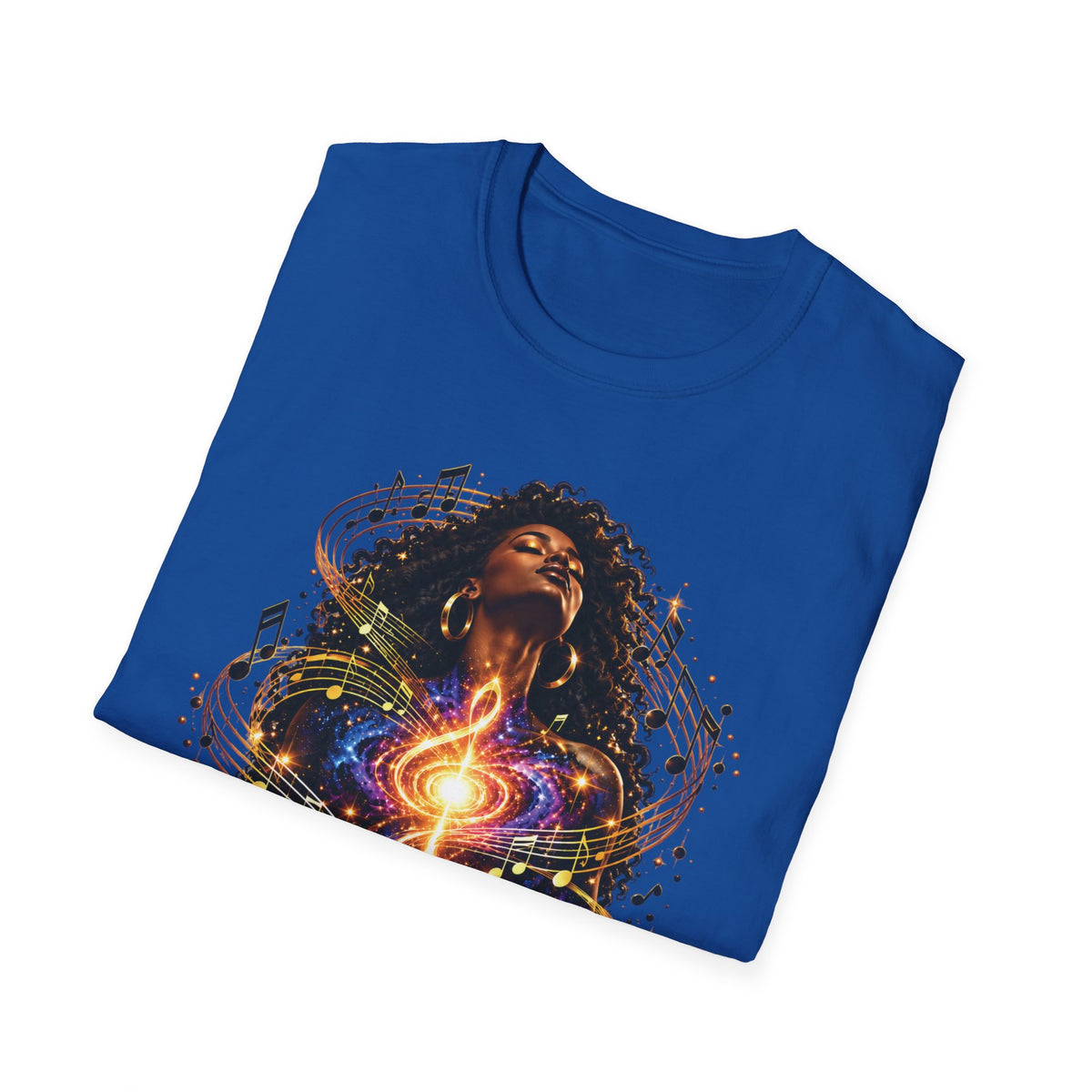
Music Is in My Soul V1 (Female) – Gildan 64000 T-Shirt
Music Is in My Soul V1 (Female) – Gildan 64000 T-Shirt
Couldn't load pickup availability
- 30-Day Guarantee
- Easy Returns
- Fast Shipping
Product Description
Product Description
The “Music Is in My Soul” tee is made for anyone who feels music as something deeper than sound. The design features a powerful Black woman surrounded by flowing musical notes, cosmic energy, and a radiant light glowing from within. The combination of gold, deep blues, purples, and celestial details gives the artwork a spiritual, expressive feel—symbolizing music as energy, emotion, creativity, and something that lives within the soul.
Printed on a Gildan 64000 Softstyle T-Shirt, this piece gives you statement artwork without sacrificing everyday comfort. The shirt has a smooth, lightweight feel with a clean unisex fit that works well for casual wear, layering, concerts, creative spaces, or simply expressing your love for music. The soft fabric also provides a great surface for the detailed colors and intricate artwork to stand out.
More than just a graphic tee, “Music Is in My Soul” represents the connection between rhythm, spirit, and self-expression. It is designed for singers, musicians, artists, creators, and anyone who understands how deeply music can move the mind, body, and soul. Wear it as a reminder that music is not just something you listen to—it is something you carry within you.
Fast and Easy Returns
Fast and Easy Returns
We have a 30-day return policy, which means you have 30 days after receiving your item to request a return.
To be eligible for a return, your item must be in the same condition that you received it, unworn or unused, with tags, and in its original packaging. You’ll also need the receipt or proof of purchase.
To start a return, you can contact us at info@ourvibewear.com.
If your return is accepted, we’ll send you a return shipping label, as well as instructions on how and where to send your package. Items sent back to us without first requesting a return will not be accepted.
You can always contact us for any return question at info@ourvibewear.com
Damages and issues
Please inspect your order upon reception and contact us immediately if the item is defective, damaged or if you receive the wrong item, so that we can evaluate the issue and make it right.
Exceptions / non-returnable items
Certain types of items cannot be returned, like perishable goods (such as food, flowers, or plants), custom products (such as special orders or personalized items), and personal care goods (such as beauty products). We also do not accept returns for hazardous materials, flammable liquids, or gases. Please get in touch if you have questions or concerns about your specific item.
Unfortunately, we cannot accept returns on sale items or gift cards.
Exchanges
The fastest way to ensure you get what you want is to return the item you have, and once the return is accepted, make a separate purchase for the new item.
European Union 14 day cooling off period
Notwithstanding the above, if the merchandise is being shipped into the European Union, you have the right to cancel or return your order within 14 days, for any reason and without a justification. As above, your item must be in the same condition that you received it, unworn or unused, with tags, and in its original packaging. You’ll also need the receipt or proof of purchase.
Refunds
We will notify you once we’ve received and inspected your return, and let you know if the refund was approved or not. If approved, you’ll be automatically refunded on your original payment method within 10 business days. Please remember it can take some time for your bank or credit card company to process and post the refund too.
If more than 15 business days have passed since we’ve approved your return, please contact us at info@ourvibewear.com
Washing Instructions
Washing Instructions
Always wash separately before wearing to avoid bleeding issues
Maximum washing temperature 30 C, inside out, with like colors
- Only oxygen/non chlorine bleach allowed
- Tumble dry at low temperature, max 60 C
- Do not iron
- Do not dry clean
Important note: Please read label instructions carefully for all garments.



MUSIC IS
Music has always been more than entertainment in Black life—it has been a way to survive, communicate, remember, celebrate, mourn, resist, worship, and tell the truth. Rhythm, call-and-response, improvisation, storytelling, and communal participation have deep roots in African musical traditions, and those elements continued to evolve across the African diaspora. Even under slavery, when Black people were stripped of language, family ties, freedom, and cultural institutions, music became one of the strongest ways to preserve identity and create connection. Spirituals, work songs, field hollers, and coded songs carried emotion, faith, memory, and sometimes messages of escape or resistance.

IN MY
As Black communities moved through emancipation, segregation, migration, and the Civil Rights era, Black music kept evolving with them. Blues gave voice to pain, love, hardship, and endurance. Gospel turned struggle into testimony. Jazz transformed improvisation into a sophisticated musical language that reshaped modern music. Rhythm and blues, soul, funk, reggae, and later hip-hop became powerful expressions of Black creativity, political awareness, style, and community. Black musicians did not simply participate in American popular music—they were foundational to its development, influencing rock and roll, pop, country, electronic music, dance music, and countless genres around the world.

SOUL
That is part of what makes the idea “Music Is in My Soul” so powerful. For Black people, music has often carried the memory of generations. It has been passed down through churches, families, neighborhoods, marching bands, clubs, studios, barbershops, block parties, and HBCU traditions. A melody can carry grief and joy at the same time; a drumbeat can connect the present to something much older. Black musical history shows how people can take struggle and turn it into beauty, take limitation and turn it into innovation, and take individual experience and transform it into something an entire world can feel.